When your spouse is leaving
You did not ask for this. Your marriage is not over because their beliefs changed. What the couples who make it do differently.
You married a believer, in the temple, with a promise about forever, and the person across the table has changed the terms without your consent. That is a real loss and you are allowed to grieve it. You are also allowed to be angry, frightened for the children, and worried about eternity. All of that is normal. None of it means your marriage is ending.
What is true
- Most marriages survive one spouse’s faith crisis. The ones that end usually had other trouble already.
- Your spouse did not choose this. Belief does not respond to willpower; they cannot decide to believe again any more than you can decide to stop.
- They are terrified of losing you. Much of their anger and withdrawal in the first months is fear.
- They are still the person you married. The values, the history, the love: those came from character, not from a testimony.
- The Church’s teaching that you will be separated in the eternities is a source of enormous pain for believing spouses. You do not have to resolve it now, and many believing members have found ways to hold hope for their family that the doctrine did not spell out.
What helps
- Separate the marriage from the Church question. You can disagree about God and be a team. Say it out loud.
- Ask what they are feeling before what they have read. The history is not the point. The fear is.
- Do not send the bishop. Involving him before your spouse is ready makes him a party to the marriage and breaks trust.
- Get your own support. A believing friend who will not gossip, a therapist of your own, the LDS Women Project, mixed-faith marriage series series or At Last She Said It if you are a woman, Jennifer Finlayson-Fife for the marriage. You are entitled to help too.
- Negotiate the practical things one at a time. Tithing, garments, Sunday, the children. Nobody’s beliefs get to govern the other’s body or conscience; shared things get shared decisions. Your marriage, and the mixed-faith marriage is the same guide from your spouse’s side; read it.
- Go to couples counselling early, with someone who is neutral about the outcome. It works far better in month three than in year three.
- Keep giving each other things. They go to the ward party; you go on the Sunday hike. Marriages run on generosity.
What makes it worse
- Ultimatums, in either direction.
- Trying to bring them back. It does not work and it costs the trust you will need.
- Reading their doubt as rejection of you.
- Letting your parents or the ward into the marriage’s decisions.
- Using the children as leverage, or as spies.
Your own faith
Some believing spouses find their own faith deepens through this; some find it changes; some find, years later, that they had questions too and had never let themselves ask. All of those are yours to work out, in your own time, and your spouse’s job is to give you the same respect they are asking for. If you want to understand what they found, the Gospel Topics Essays are the Church’s own account and a safe place to start. You do not have to read anything.
The couples who make it
Allan and Kattie Mount, a believing wife and non-believing husband, have recorded their marriage for years on Marriage on a Tightrope, and told their story on episodes 40 Thriving as a Mormon Mixed-Faith Couple – Kattie and Allan Mount to 42 Thriving as a Mormon Mixed-Faith Couple – Kattie and Allan Mount of the podcast. They are not unusual. They just decided the marriage mattered more than the outcome, and kept deciding it.
From the podcast

Healthy Marriage
In these episodes, John and Margi have a discussion with Natasha Helfer Parker, LCMFT, CST about forming a foundation for marriage that withstands change. They also discuss guiding principles to maintaining successful…

Thriving as a Mormon Mixed-Faith Couple – Kattie and Allan Mount
Join us today on The Gift of the Mormon Faith Crisis as Allan and Kattie Mount share with us their top tips for thriving as a Mormon mixed-faith couple. Allan and Kattie Mount co-host the “ Marriage on a Tightrope ”…
Stories on this
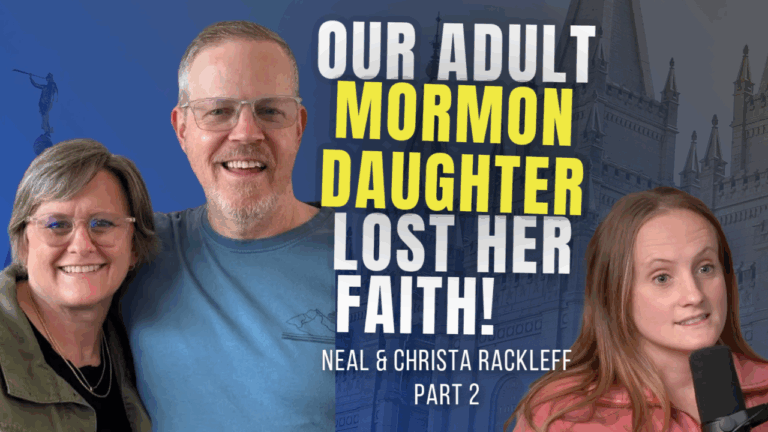 Our Adult Mormon Daughter Lost Her Faith! w/ Neal & Christa Rackleff | Ep. 2018
 How to Improve Your Marriage After One of You Loses Their Testimony | Ep. 157-159
 Navigating a Marriage When One Loses Their LDS Testimony | Ep. 182-185
 How We Almost Ruined Our Mixed-Faith Marriage | Ep. 1799
 When Your Sister Leaves the Mormon Church – Meggan & Julie O’Neal | Ep. 2144
 400: Top 5 Myths and Truths about Why Committed Mormons Leave the Church