
Parents, siblings and extended family
The people who raised you may need years. How to be honest with them and still patient, and how to set a boundary without a war.
Your parents are not being difficult when they take this hard. From inside the Church, a child leaving is the failure of the one thing they were told mattered most, and it threatens the family they were promised in the next life. Their grief is proportional to their love. That does not mean you have to absorb it, but it helps to know what it is.
What they are afraid of
That they failed. That you were led astray by someone. That you are in danger, now and eternally. That you will drink, divorce, lose the children. That the family will be broken up in the celestial kingdom. That other members will judge them. Most of what they say in the first year comes from one of those fears, and most of it is not really about you.
How to tell them
- In writing first, if you can. A letter lets them read it twice and cry in private. The letter to believing parents is a template.
- Say who you still are before you say what changed. Honest, hard-working, kind, theirs.
- Take the stereotypes off the table in advance. “This was not about sin or being offended.” They will think it anyway, for a while.
- Tell them what you need. To still be their child. To not be a project. To not have the bishop sent round. To have this not be the only subject.
- Do not bring the evidence. Offer it, once, and leave it. A parent who has decided not to look will not look, and your research delivered as an argument will be heard as an attack.
Boundaries
A boundary is not a threat and not a punishment. It is a statement of what you will do. “I am happy to talk about anything, but if the conversation turns into trying to bring me back, I am going to leave the room” is a boundary. Then leave the room, kindly, every time. Most families learn within a few months.
Some specific ones that help:
- Church talk is fine one-on-one, not at family dinner.
- Nobody sends the missionaries, the bishop or a General Conference talk without asking.
- The grandchildren are not the front line. Grandparents can share their faith with them lovingly; they cannot undermine their parents.
- Holidays and family events are negotiated in advance. Holidays, family events and General Conference weekend is about that.
Siblings
Siblings are unpredictable: some become your closest allies, some feel abandoned, some are secretly relieved and tell you so at 1 a.m. two years later. Tell them individually, not as a group, and expect the reactions to be about their own faith as much as yours.
The long game
Parents come around. Not all, not fully, and not on your schedule, but the pattern we have seen over twenty years is that a parent who is not forced to choose between their child and their church usually finds a way to keep both. Keep showing up. Keep being the person they raised. Let time do what arguments cannot. Episodes 16 Communicating with Believing Family and Friends and 17 Communicating with Believing Family and Friends have a whole evening of listener stories about exactly this.
In their words
From the podcast. Machine transcripts, lightly edited; the video is authoritative.
“People can smell an agenda from miles away. There's something really different about a connecting conversation, where the purpose is to connect and communicate in a free, respectful way, and one with an agenda, where you're actually trying to push something.”
From the podcast

Communicating with Believing Family and Friends
Part 1: In this episode, recorded January 10, 2017, we discuss tips on communicating with Orthodox/Believing Mormons. Co-hosts are John and Margi Dehlin. Today’s Panelists: *Amy Grubbs *Shandi Hill, Moderator for…

Communicating with Believing Family and Friends after a Faith Transition (August 2019 THRIVE Retreat)
Recorded at the THRIVE Retreat, 8/30 – 9/1/2019 in Salt Lake City, Utah – including the participation of ~40 audience members. Communicating with Believing Family and Friends after a Faith Transition: Other topics…
Stories on this
 When Your Sister Leaves the Mormon Church – Meggan & Julie O’Neal | Ep. 2144
 Leaving the LDS Church as a Young Adult in the U.K. – Douglas Stilgoe | Ep. 1345
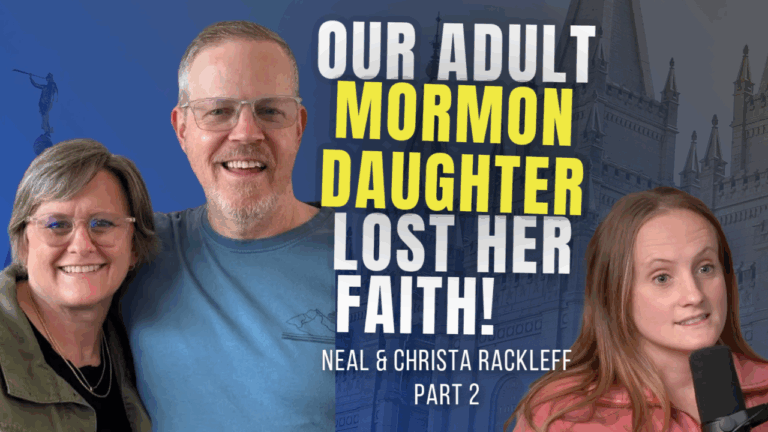 Our Adult Mormon Daughter Lost Her Faith! w/ Neal & Christa Rackleff | Ep. 2018
 650-652: One Ordinary Family’s Extraordinary Mormon Transition
 1457: Lessons I’ve Learned Leaving the Mormon Church as a Teen – Brinley Young
 616-617: Thirteen Years of Silence – Matt Elggren and Clay Christensen’s Story of Family, Faith, Doubt, and Hope