Scrupulosity, or religious OCD
Intrusive fears of sin, endless confession, guilt out of all proportion. Common in high-demand religion, often unmasked by a faith crisis, and treatable.
Scrupulosity is obsessive-compulsive disorder with religious content: intrusive thoughts that you have sinned or will, compulsive checking, confessing, praying or ritual to make the anxiety stop, and guilt wildly out of proportion to anything you have done. It is common among Latter-day Saints, partly because the Church’s culture of worthiness interviews, perfectionism and “every thought” rewards exactly the habits that OCD runs on. John’s master’s research was on treating it.
What it looks like
- Confessing the same thing to the bishop repeatedly because the first confession did not “count”.
- Being unable to take the sacrament for years over something nobody else would notice.
- Intrusive blasphemous or sexual thoughts, and terror that having them is the sin.
- Hours of prayer that never produce relief.
- After leaving: the same machinery running on new content. “What if I am wrong and I have damned my children?” at 4 a.m., every night.
Why a faith crisis makes it worse and then, often, better
In the short term, the crisis removes the relief valve. You cannot confess to a bishop you no longer trust, and the doubt itself becomes the intrusive thought. In the longer term, many people find the scrupulosity fades as the framework that fed it fades, and what is left is ordinary anxiety they can treat. Some find the OCD simply moves house, to health or safety or contamination; that is still OCD and still treatable.
What works
The evidence-based treatments are exposure and response prevention (ERP) and acceptance and commitment therapy (ACT). Both teach you to let the intrusive thought be there without doing the compulsion, until the anxiety learns it does not need to fire. The Acceptance and Commitment Therapy as a Treatment for Scrupulosity (paper) paper is the study John was part of; show it to a therapist if they have not seen it. Medication (usually an SSRI) helps many people alongside therapy.
What does not work is more reassurance, more confession, more research, or trying to argue the thought away. Those are the compulsions.
Finding the right therapist
You want someone who treats OCD, not someone who will pray with you or someone who will tell you religion was the whole problem. Look for ERP or ACT in the profile; see Finding a therapist who understands. The International OCD Foundation’s directory lists clinicians by specialty.
If this is you
Scrupulosity is not a sign that you were more righteous than other people or more sinful. It is a brain that got very good at a loop the environment rewarded. The loop can be unlearned. People who have carried this for decades routinely get most of their life back in months of proper treatment.
Stories on this
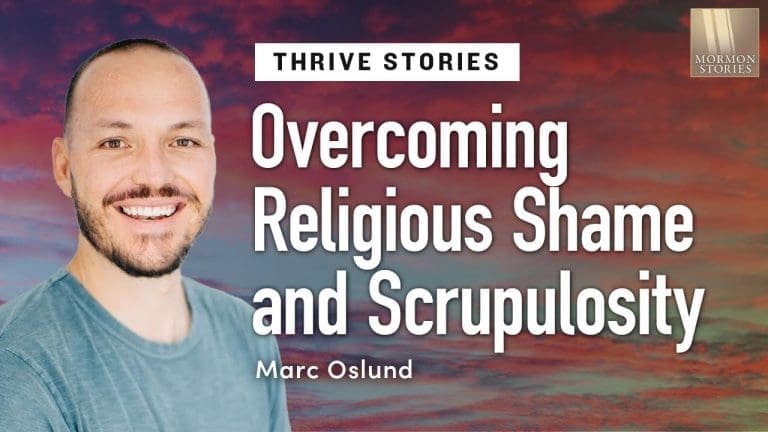 Overcoming Religious Shame and Scrupulosity – Marc Oslund | Ep. 1598
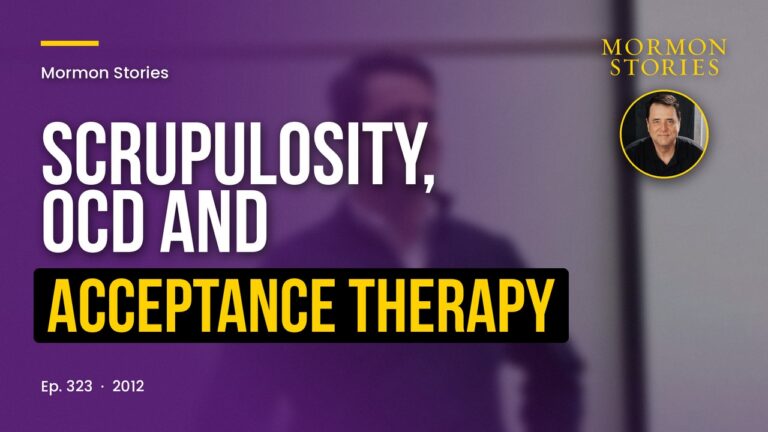 323: Scrupulosity, OCD and Acceptance and Commitment Therapy with John Dehlin
 229-230: Understanding Scrupulosity Within the LDS Church
 1480: The Sources of Mormon Sexual Shame – Natasha Helfer
 Doubting as a Mormon Missionary and in Early Marriage – Dallin Seely (@TheDashleys) | Ep. 1729
 My Troubled Teen Center Nightmare – Becky Loveless Pt 1 | Ep. 1852