Grief
A faith crisis is a bereavement, and it behaves like one. What you are grieving, what the waves feel like, and what to do with the anger.
Nobody tells you that losing your religion feels like a death, because from inside the Church it does not look like a loss. It looks like a choice, or a fall. From inside your own head it is a bereavement, and treating it as one is the single most useful reframe we know.
What you are grieving
Make the list. Most people are surprised how long it is.
- A worldview that explained everything, and the certainty that came with it.
- An afterlife, and the promise of being with your family forever.
- God, or a particular God, and the relationship you had with him.
- A community that knew your name and would bring casseroles.
- A calendar, a purpose, a plan for your life that was already written.
- Your parents’ approval and your standing in your family.
- Your past: the mission, the tithing, the years, the things you said to others.
- The version of yourself who believed, whom you may have liked.
- Sometimes, the marriage as it was.
Each of those is a real loss. Grieving nine losses at once is a lot. Give yourself the allowance you would give a widow.
What it feels like
Grief comes in waves, not stages. Sadness, then rage, then numbness, then a strange lightness, then guilt for the lightness, then sadness again, in an afternoon. Panic shows up too, especially about the unknown: you used to have an answer for death and now you do not. Sleep goes. Concentration goes. Some people cannot stop crying; some cannot start. All of it is normal grief and all of it eases with time, usually over one to three years, with the sharp edges gone much sooner.
Anger
Anger is the part of grief people feel worst about, because the Church taught them it was a sin and their family reads it as bitterness. It is neither. Anger is what hurt feels like on its way out: you were told things that were not true by people you trusted, and you organised your life around them. Of course you are angry.
Two things help. First, let it have an outlet that does not land on your family: writing, running, a therapist, a friend who has been through it. Second, Margi’s question: what is under the anger? Usually it is grief, or fear, or shame, and those are softer to hold.
What helps
- Name it as grief, to yourself and to the people close to you. “I am grieving” is easier for a spouse to hear than “I am angry at the Church”.
- Make time for it. Margi sets aside time deliberately, still, years later. Grief that is scheduled is less likely to ambush you.
- Write. A journal, a letter you do not send, a story for wasmormon.org. Putting it into words moves it.
- Move your body. It is where the stress lives.
- Find people who have been through it. A THRIVE group, a Facebook group, one friend. Grief is lighter shared.
- Keep some rituals. Sunday still needs a shape. Sacred music is still yours.
- Get help if the waves are not passing. Grief that stays flat and heavy for months, or that comes with thoughts of not wanting to be here, has become depression, and depression is treatable. Anxiety and depression and Finding a therapist who understands are next.
The other side
Grief ends by becoming something else. The people you meet years down the road are not grieving any more; they have built a life the old one could not have contained. Episodes 24 The Essential Role of Grief in a Mormon Faith Crisis to 27 The Essential Role of Grief in a Mormon Faith Crisis are the podcast’s four evenings on grief, and Anthony Miller’s 51 Anthony Miller – Growing Beyond Grief, Loss, and Betrayal After a Mormon Faith Crisis is one man’s account of growing beyond it.
In their words
From the podcast. Machine transcripts, lightly edited; the video is authoritative.
“You lose so much. You lose spirituality, sometimes a sense of meaning and purpose, family, friends, community, your solace about the afterlife. It can affect your relationships in very real ways. So of course you're going to feel awful, and of course it's going to take time to rebuild.”
“Erin writes: there also seems to be a panicky aspect to grief. Every so often I get flashes of panic with the unknown. I used to have answers for everything and now I don't. My new normal is not knowing, and feeling at peace with it. I really love that groundlessness.”
“What is going on beneath the anger? Sometimes that can loosen the process a little bit and get you tapped into the vulnerability, the deeper things going on inside you. Anger has an energy to it, and it helps sometimes to drop down a bit.”
From the podcast

The Essential Role of Grief in a Mormon Faith Crisis
Join us now for a new series of “The Gift of the Mormon Faith Crisis.” Our focus will be on exploring and applying the extended Kubler-Ross Model for grief to a Mormon Faith Crisis. We heartily welcome your questions,…

Anthony Miller – Growing Beyond Grief, Loss, and Betrayal After a Mormon Faith Crisis
Presented by Anthony Miller at the June 2019 THRIVE Conference in Salt Lake City, Utah. NOTE: If you enjoy(ed) this presentation, please join us November 17th for THRIVEDAY2019. THRIVEDAY2019 will be an entire day…
Stories on this
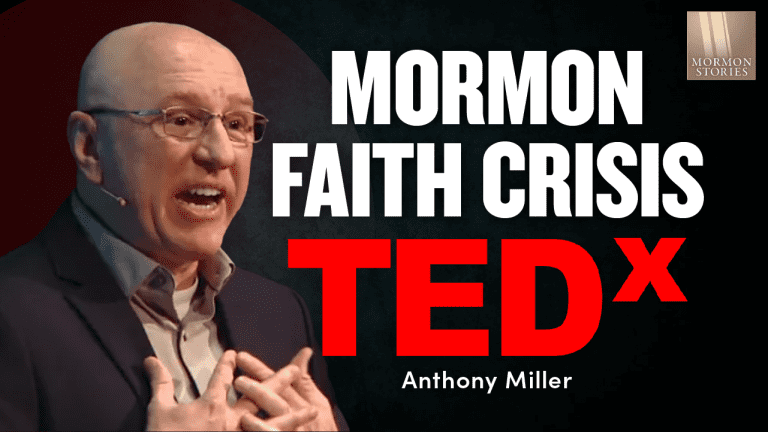 Mormon Faith Crisis Journey TEDx w/ Anthony Miller | Ep. 1593
 707-708: Death, Loss, and Grief
 1166-1167: Anthony Miller – Growing Beyond Grief, Loss, and Betrayal After a Mormon Faith Crisis
 1402: Finding Spirituality After Mormonism
 Tommy “THETOMSTERS” & Madison Johnson | Ep. 1678
 The Dark Side of a Mormon Mission – Brinley Jensen | Ep. 1680-1681